By: Ashfaq Mir
For years, relations between India and the Arab world were viewed within a limited framework—energy needs, the presence of migrant workers, and formal diplomacy. However, Prime Minister Narendra Modi’s recent visit to Jordan, Oman, and Ethiopia marks a clear departure from this traditional approach. These are not merely routine visits; they signal a structural transformation in India’s role across the Gulf and the wider Arab region. This shift is rooted in confidence and continuity in India’s foreign policy.
In Jordan, King Abdullah II’s open praise for India’s economic progress and Prime Minister Modi’s leadership was not just a gesture of goodwill but an acknowledgment of the fact that India has emerged as a decisive force in the global economy. The King’s vision of an economic corridor linking South Asia, the Middle East, Africa, and Europe indicates that Arab leadership now views India as a central pillar in future global supply chains.
The Jordanian Crown Prince personally escorting Prime Minister Modi to a museum and then seeing him off at the airport was an extraordinary diplomatic gesture. In international politics, such actions go beyond protocol; they reflect trust, respect, and a commitment to long-term partnership. This signifies that India is no longer seen merely as a partner, but as a credible and respected leader.
The target of expanding bilateral trade between India and Jordan to five billion dollars over the next five years, along with cooperation in renewable energy, water management, digital public infrastructure, and cultural exchanges, reflects a changing reality: India is now exporting not only products, but also systems, technologies, and development models. While political harmony was evident in Jordan, economic confidence was on full display in Oman.
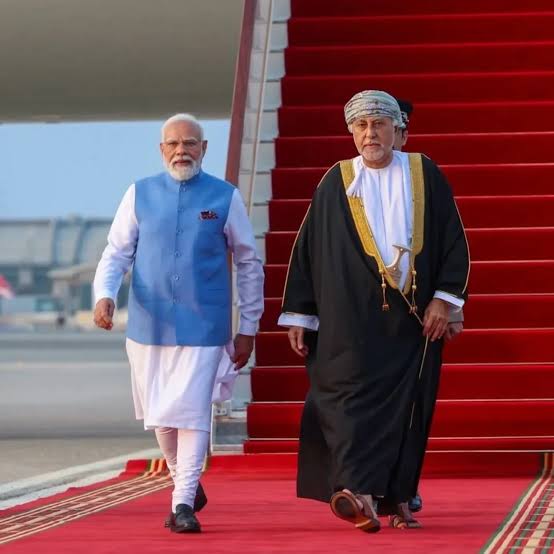
Prime Minister Modi being conferred with the “Order of Oman,” the country’s highest national honour, was an exceptional diplomatic event. This was not merely an award, but a seal of approval on India’s global standing. The fact that five out of six Gulf Cooperation Council countries have bestowed their highest honours on Prime Minister Modi underscores India’s extraordinary acceptance in the Gulf.
The Comprehensive Economic Partnership Agreement between India and Oman is a practical manifestation of this trust. It is only Oman’s second major trade agreement in nearly two decades—the first being with the United States. Near-complete duty-free access for Indian exports will create new employment opportunities and open fresh avenues for MSMEs, women-led enterprises, and skilled professionals. At the same time, allowing 100 percent foreign investment in the services sector will further strengthen India’s position as a global talent hub.
It is noteworthy that when Narendra Modi came to power, there were apprehensions that India’s relations with the Arab world might suffer. Reality, however, has proved quite the opposite. Today, the Arab world is not only deepening ties with India with warmth, but also viewing it as a stable, reliable, and non-interventionist partner.
Modi’s Arab diplomacy reflects the fact that India is no longer confined to any ideological bracket, but is shaping its interests and partnerships as a sovereign global power. At a time when the global order is marked by instability, India has emerged for Gulf countries as a partner that offers cooperation without pressure, conditions, or interference.
Ultimately, this visit announces that India’s foreign policy is no longer reactive, but driven by vision, confidence, and long-term strategy—and the Arab world is not only acknowledging this new Indian reality, but also welcoming it.
Leave a Reply